Aisatsu

Aisatsu

This blog is for family and friends, to share my feelings and photos with and for myself, to support my fading memory. Readers who have my site translated automatically, please refer to the original if necessary. Especially when it comes to identification. Any comments, anonymous or by email name are always welcome!.

Tuesday, 23 September 2014

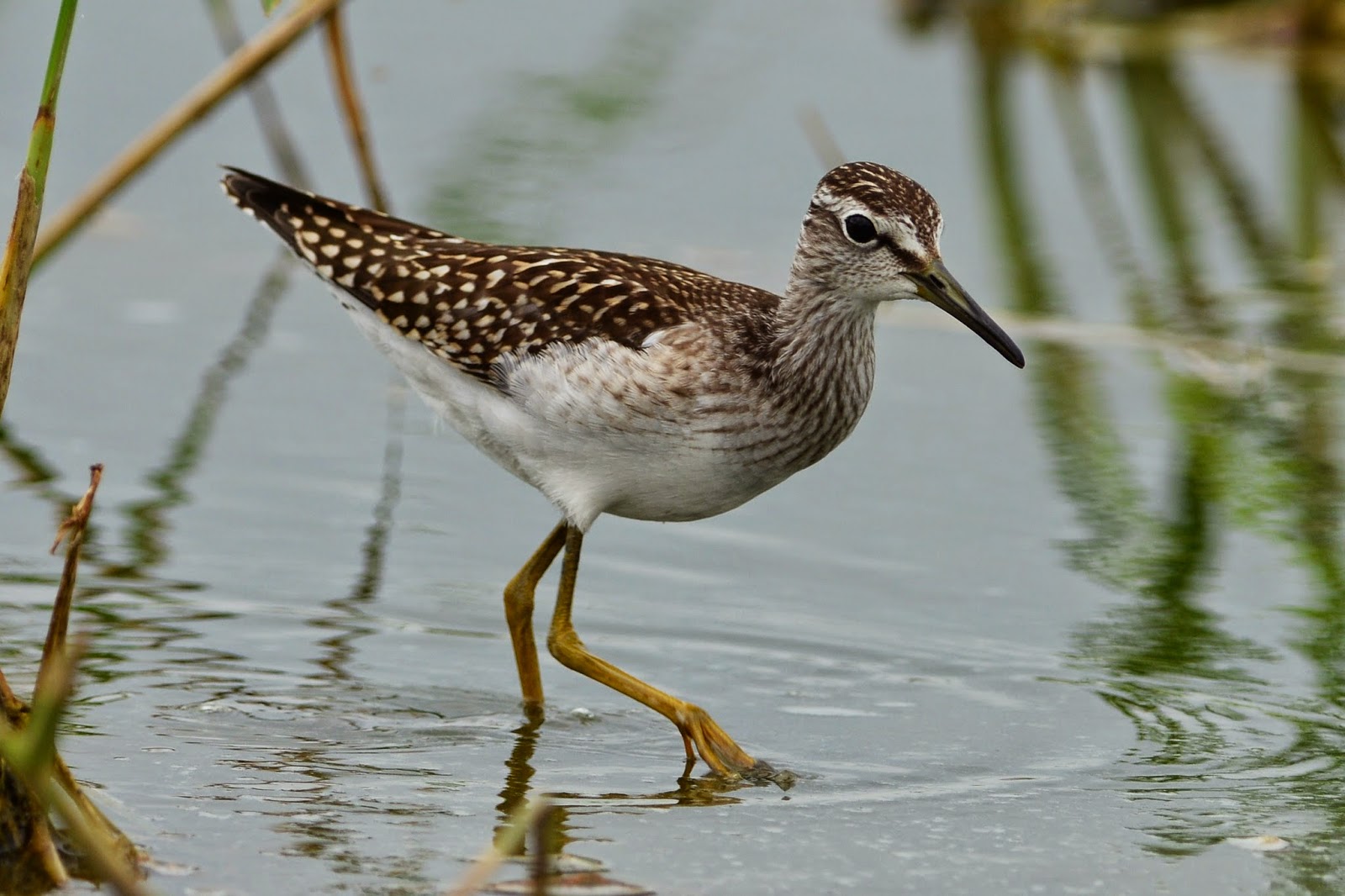
Wood Sandpiper, タカブシギ

The posts of waders wouldn't be complete without this Sandpiper. Very comon in the Imazu area and one of my favorites. They are always active and fun to watch. I think they are quite pretty as well, slender, with fine and well marked features.


always active


juvenile


Just caught a dragonfly. It seemed a bit of a struggle to rid it of unedible wings.


Pretty feathers up to under the wings.


not too shy, coming this close it hardly fits in my frame

Friday, 19 September 2014

Terek Sandpiper, ソリハシシギ

A fairly common migrant that we see every year around Fukuoka, but never in big numbers. Easily distinguished from other sandpipers by the upturned bill. The name Terek comes from the river Terek in Russia.


With pink colored snail eggs at the back .


Pretty orange-colored legs in summer


Early evening scene

Thursday, 18 September 2014

Ruff, エリマキシギ

Large shore birds with long legs, migrating from the cold tundras of East Russia to the warmer shores of SE Asia and beyond. There were 8 of them in Imazu at one time. Hanging around for over a week. I'd love to see these birds in breeding plumage!


Portrait, I think a female.


Huddling together when raptors fly by. The smaller one on the left should be a female, the males are about 20% larger, In the back one black-winged Stilt


Wandering off in pairs or by themselves when the danger has gone.


Sunday, 14 September 2014

Once in a life time, Spoon-billed Sandpiper, ヘラシギ

It was the first time for me to see this bird.

This critically endangered bird is very small and looks like any other small wader from a distance. When it mingles with stints of the same size it's nearly impossible to detect. However, its spatula-shaped bill makes it very special and it appears on many birders' wishlist.
Somebody spotted it and sent the word out. The following day (a Saturday) many birders drove to the mudflats of the Ariake Sea.

The search started on the upcoming tide, which drove the birds close to shore. At the top of the tide, when all the mud was submerged thousands of waders took refuge on the rocks lining the flat. A Peregrine Falcon sent them all flying again few times and when the tide went out all birds returned to the extensive mud.


Between 2 Broad-billed Sandpipers


At the back behind the dunlins


To the right of the dunlin

I was lucky to see it on 3 occasions, thanks to the help of people with digital scopes. Taking photos was extremely hard, because the tiny bird kept on disappearing behind rocks and other bigger birds. It also moved very fast, sending waves of panic and frustration through the group of photographers.


Just about to vanish behind the rocks.


Out on the mudflat again (glad the falcon didn't get it). The bird in the back is a juvenile Grey Plover and about twice as big.


There are only a few hundred of these birds left in the world and I feel very lucky that I was able to see this little bugger. It might never happen again...
Sunday, 7 September 2014

Stints!

Red-necked Stint, トウネン, Temminck’s Stint, オジロトウネン and Long-toed Stint, ヒバリシギ.
They are the smallest migratory waders in our area. about 13 - 16 cm. Feed mainly on insects on soft mud and among grass. I always watch for them, specially at wider mudflats of the Ariaki Sea, hoping to see the Little Stint one day or the similar sized Spoonbill Sandpiper!


Gregarious birds with a small black bill and black legs, the Red-necked Stint, トウネン

-----


The  Temminck’s Stint, オジロトウネン looks similar, but has yellow legs and more brown-grey upper parts. It's not seen in big groups, usually and has a complicated parenting system, where the male looks after the eggs of the female, who leaves him to lay her own second clutch in a different location, often teaming up with another male, who might be abandonned by his ex...

-----


Last but not least, Long-toed Stint, ヒバリシギ, A pretty, slender, brownish bird with short bill, yellow legs and long toes.


Friday, 5 September 2014

Brown Shrike, アカモズ

Seen regularly in Malaysia and now right here in Fukuoka on the last day of August - my first sighting in Japan!


That was an exciting finale of the summer holiday.


Thursday, 4 September 2014

Black-tailed Godwit, オグロシギ

A near-threatend migrating bird that covers great distances. It might fly from Japan to Australia in just under a week. I felt lucky to see these magnificant 2 up close, so took too many photos - again.


With stilts in the back 


First there was just 1 bird, a day later the 2nd one flew in. They seem close.